
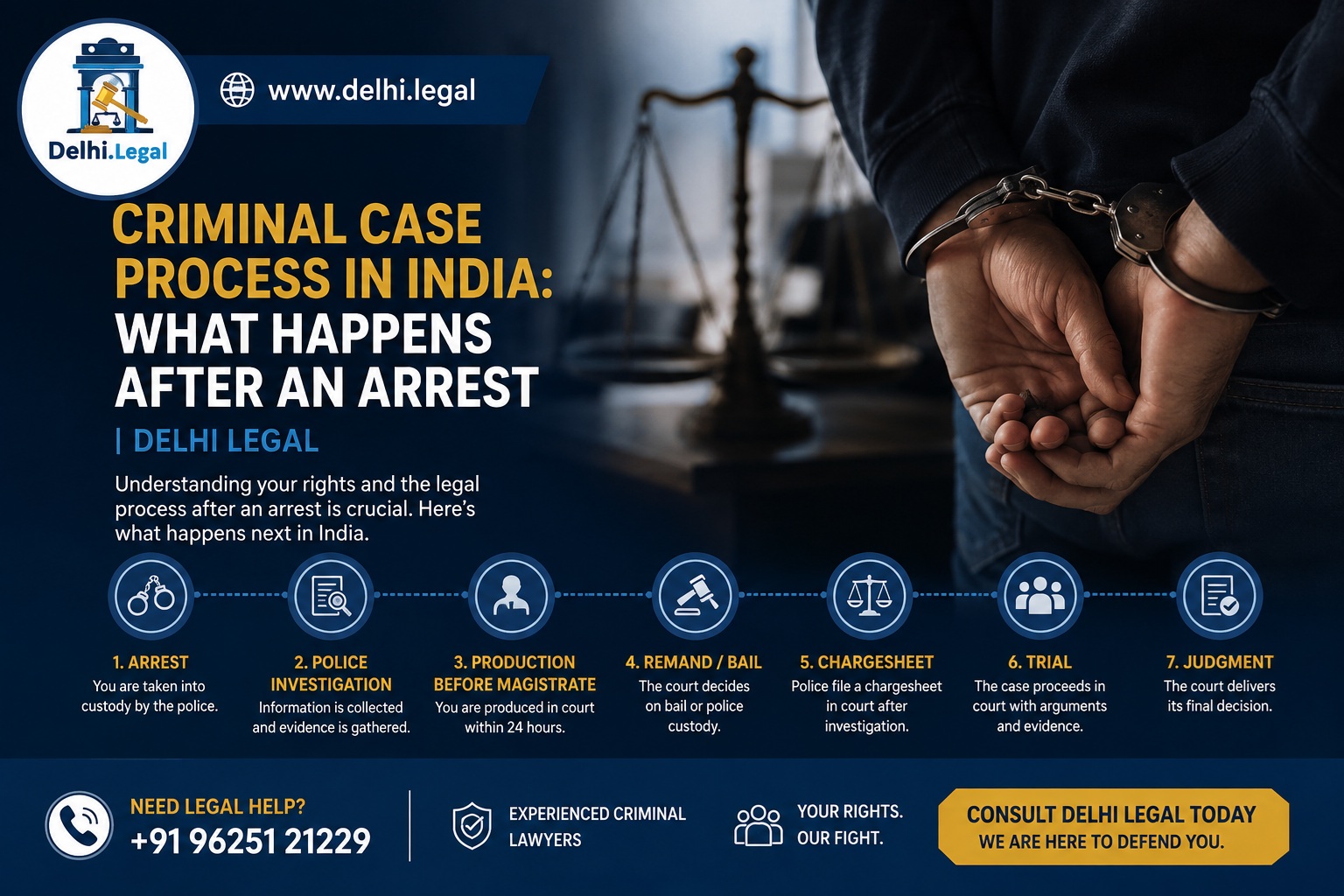

Most people in Delhi learn how a criminal case works at the worst possible moment: standing at a police station at 11 at night, holding a phone, trying to remember whether they are allowed to make a call.
That is a bad time to start reading. So here is the criminal case process in India laid out from the beginning, in the order it actually happens, with the parts that matter to you marked clearly.
One thing before we start. Since 1 July 2024, India runs on three new criminal laws. The Bharatiya Nyaya Sanhita (BNS) replaced the Indian Penal Code, the Bharatiya Nagarik Suraksha Sanhita (BNSS) replaced the Criminal Procedure Code, and the Bharatiya Sakshya Adhiniyam replaced the Evidence Act. Section numbers have changed. Older articles on the internet still quote IPC and CrPC numbers, which is why the equivalents are given in brackets below.
It starts with an FIR, not an arrest
A criminal case usually begins when someone walks into a police station and reports a cognisable offence. The officer records it as a First Information Report under Section 173 BNSS (old Section 154 CrPC).
Two things worth knowing here. If the offence happened outside that station’s area, they still have to register it as a Zero FIR and transfer it. The BNSS made that a statutory duty rather than a courtesy. And for offences punishable by three to seven years, the police can now take up to fourteen days to run a preliminary enquiry before registering a regular FIR.
You are entitled to a free copy of the FIR. Ask for it. If a complaint has been filed against you, that document tells your criminal lawyer more in five minutes than an hour of conversation will.
Arrest, and what happens in the first 24 hours
Not every FIR ends in an arrest. Police can, and often do, simply issue a notice under Section 35(3) BNSS asking you to appear. Ignoring that notice is a mistake. It converts a manageable situation into an arrestable one.
If you are arrested, the clock starts.
You must be produced before a magistrate within 24 hours, excluding travel time. This is not a police courtesy, it is Article 22 of the Constitution. Someone of your choosing has to be informed of the arrest and where you are being held. You are entitled to meet a lawyer during interrogation, though not necessarily to have one present throughout it. A woman cannot be arrested after sunset or before sunrise except with a magistrate’s written permission. And an arrest memo has to be prepared, signed by a witness, and countersigned by you.
Delhi has a further layer. All police stations in the capital are supposed to display arrest information at the DCP office and update the Delhi Police online arrest database, so families can confirm where a person is being held instead of driving between three stations at midnight.
Remand, custody, and the bail window
At the first production, the magistrate decides who keeps you. Police custody means you go back with the investigating officer for questioning. Judicial custody means you go to jail while the investigation continues. Under Section 187 BNSS (old Section 167 CrPC), police custody is capped at fifteen days in total, though the BNSS now allows those fifteen days to be taken in parts across the first forty or sixty days.
This is also the point where a bail application is usually moved. If the offence is bailable, bail is a matter of right and the police themselves can release you on bond. If it is non-bailable, you apply to the magistrate under Section 480 BNSS (old Section 437 CrPC), and if that fails, to the Sessions Court or High Court under Section 483 (old Section 439).
There is a second, less discussed route. If the police do not file a chargesheet within 60 days for most offences, or 90 days for offences carrying death, life imprisonment, or ten years or more, you get default bail under Section 187(3). It is a statutory right, not a favour. The court cannot refuse it if you are ready to furnish surety. It is also easy to miss, because the right lapses the moment the chargesheet is filed. Diary the date.
The investigation and the chargesheet
While all this is happening, the police are collecting statements, seizing documents, and sending things to the forensic laboratory. Under the BNSS, forensic examination is now compulsory for offences carrying seven years or more. Audio-video recording of search and seizure is also mandatory, which has quietly become one of the more useful defence tools available.
The investigation ends one of two ways. Either a chargesheet is filed under Section 193 BNSS, or a closure report is filed saying there is no case. A complainant can protest a closure report. Courts do sometimes disagree with the police.
Criminal trial stages, in sequence
Once the court takes cognisance, the criminal trial stages run in a fairly predictable order.
Copies of the chargesheet and all documents are supplied to the accused. The court then hears arguments on charge. This is the first real chance to end the case, because if the material does not disclose an offence even taken at face value, the accused is discharged. If charges are framed, the accused pleads guilty or not guilty.
Prosecution evidence comes next. Witnesses are examined, then cross-examined by the defence. In most Delhi trials, this is the stage that consumes years, largely because witnesses do not appear.
After prosecution evidence closes, the accused is questioned under Section 351 BNSS (old Section 313 CrPC) about the circumstances appearing against them. Defence evidence follows, if the accused chooses to lead any. There is no obligation to. Then final arguments, then judgment. If there is a conviction, a separate hearing on sentence.
Appeal lies to the Sessions Court or the High Court depending on which court convicted.
Rights of the accused that people forget to use
The right to silence is real. Article 20(3) protects you from being compelled to be a witness against yourself. You do not have to sign a statement you did not make.
You have a right to legal aid. If you cannot afford a lawyer, the Delhi State Legal Services Authority provides one, and there is a legal aid counsel attached to most court complexes and to Tihar.
You have a right to a copy of every document the prosecution relies on. Under Section 230 BNSS this must now happen within fourteen days of the chargesheet.
You have a right to bail being considered on its own merits, not deferred indefinitely because the investigation is convenient.
And you are presumed innocent. That sounds like a slogan until you see how often people plead guilty to a small offence just to end the inconvenience, without being told it becomes a permanent conviction on record.
Hiring a criminal defense lawyer, and when
The honest answer is: earlier than most people do. The window where a good criminal lawyer adds the most value is the first 72 hours, before statements are recorded, before a confession is attempted, before a bail application is filed badly and creates a bad first impression with the court.
When you do speak to one, ask what stage the case is at and what the immediate next date requires. Ask whether an anticipatory bail application makes sense before an arrest happens. Ask for the fee structure in writing, split by stage, so you are not surprised at the Sessions Court appeal.
A criminal case in Delhi is slow, procedural, and largely won or lost on things that happen long before final arguments. Knowing the sequence is not a substitute for representation, but it does stop you from making the decisions that are hardest to undo.
Frequently asked questions
Q1. How long does a criminal case take in Delhi?
A magistrate trial commonly runs three to five years. Sessions cases take longer. The BNSS has introduced timelines for judgment delivery, but the backlog in Delhi’s district courts remains the main constraint.
Q2. Can I be arrested without an FIR?
Yes, in limited circumstances, such as an arrest at the scene of a cognisable offence. But an FIR must follow, and the arrest still has to satisfy the conditions in Section 35 BNSS.
Q3. Do I have to answer police questions?
You have to attend when lawfully required. You do not have to incriminate yourself, and you should not sign anything you have not read.
Q4. What is the difference between being named in an FIR and being chargesheeted?
An FIR is an allegation. A chargesheet is the police’s conclusion that there is enough material to prosecute. Many people named in FIRs are never chargesheeted.
Should I hire a criminal defense lawyer if I have only received a notice?
Yes. A notice under Section 35(3) BNSS is often the last quiet moment in a case. It is the cheapest point at which advice is useful.
If you have been named in an FIR, served with a police notice, or arrested in Delhi, speak to a criminal lawyer before you speak to anyone else. Book a consultation with the team at Delhi Legal to understand exactly where your case stands and what the next date requires.