

Bail is one of those words everyone uses and almost nobody defines correctly. It is not a punishment, it is not an acquittal, and it is not something the court grants because it likes you. Bail is the court’s decision that you can be trusted to come back for your trial without being locked up in the meantime.
That single idea explains almost every argument a bail lawyer makes.
Since 1 July 2024, bail in India is governed by the Bharatiya Nagarik Suraksha Sanhita (BNSS), which replaced the Criminal Procedure Code. The principles are largely unchanged. The section numbers are not, so the old CrPC numbers are given in brackets.
Bailable and non-bailable offences
Every offence in India is classified as bailable or non-bailable, and that classification decides how hard your life is about to be.
For a bailable offence, bail is a right. The police officer at the station can release you on a bond. Simple hurt, public nuisance, rash driving, most offences carrying under three years fall here. Nobody needs to convince a judge of anything.
For a non-bailable offence, bail is discretionary. A court has to be persuaded. Theft, cheating, criminal breach of trust, most offences carrying three years or more sit in this category. And “non-bailable” does not mean bail is impossible. It means bail has to be argued.
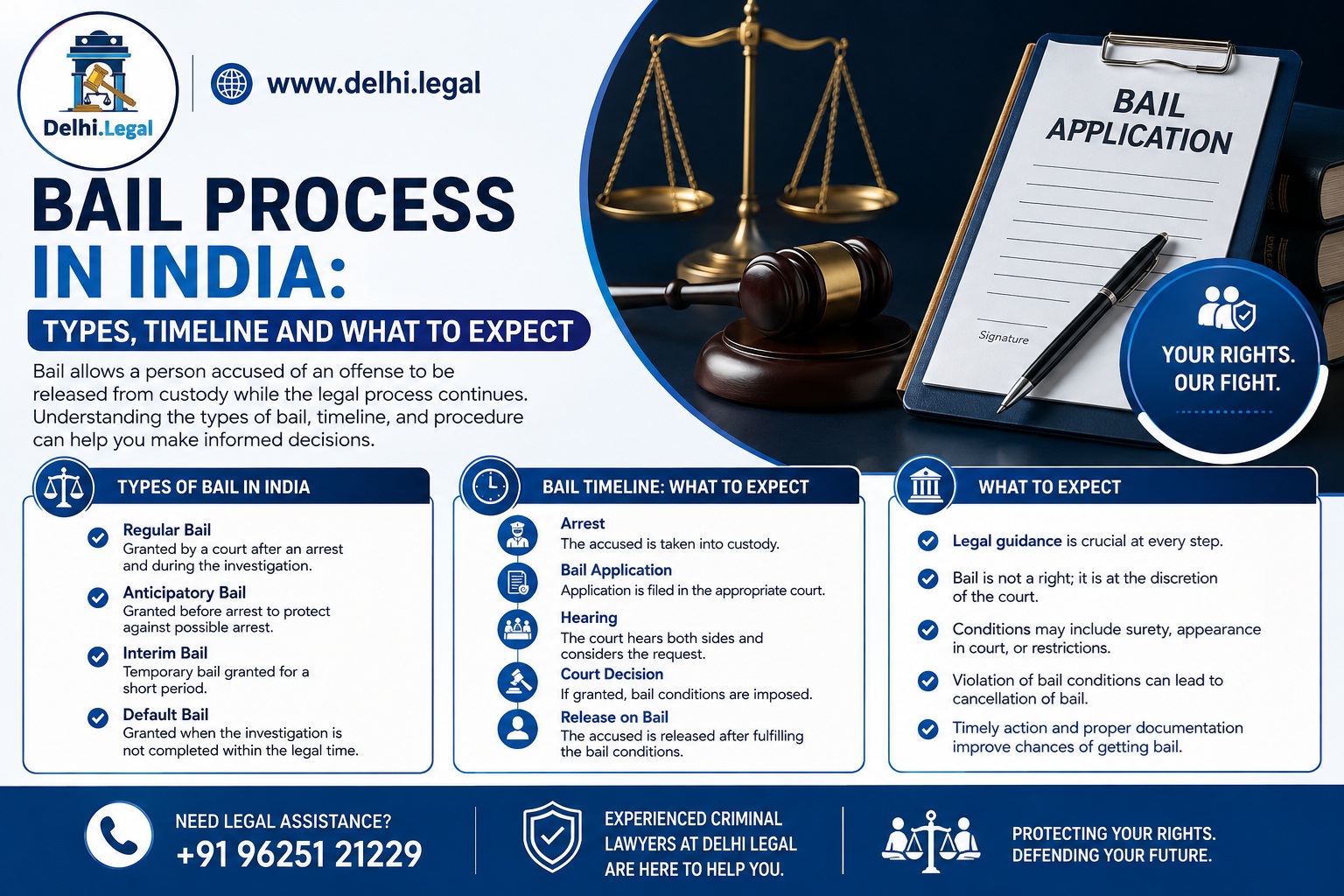
The types of bail, and which one you need
The confusion between regular bail vs interim bail vs anticipatory bail causes real problems, because applying for the wrong one wastes weeks.
Anticipatory bail is applied for before arrest, under Section 482 BNSS (old Section 438 CrPC). You use it when an FIR has been registered against you, or you have solid reason to fear one, and you want the court to direct that if arrested, you shall be released. It can only be filed in the Sessions Court or the High Court. A magistrate cannot grant it.
Regular bail is applied for after arrest, under Section 480 BNSS (old Section 437) before a magistrate, or Section 483 (old Section 439) before the Sessions Court or High Court. This is what most people mean when they say bail.
Interim bail is short-term relief granted while the main application is still being decided. Courts use it when there is urgency: a medical emergency, a death in the family, or simply because notice has to go to the prosecution and that takes a week. Interim bail is not a lesser form of bail. It is a bridge.
Default bail, under Section 187(3) BNSS (old Section 167(2)), is the one people miss. If the police fail to file a chargesheet within 60 days for most offences, or 90 days where the offence carries death, life imprisonment, or ten years or more, you become entitled to bail regardless of how serious the allegation is. The court has no discretion to refuse if you are willing to furnish surety. But the right dies the instant the chargesheet is filed, so it has to be claimed on the day it arises.
Statutory bail for long undertrial custody comes from Section 479 BNSS (old Section 436A). If you have already spent half the maximum sentence in custody as an undertrial, you are entitled to release. For a first-time offender, the threshold drops to one-third.
The bail process in India, step by step
An application is drafted and filed in the appropriate court. For an arrested person, this usually happens at the first production or immediately after.
The court issues notice to the prosecution. The Additional Public Prosecutor calls for a status report from the investigating officer. In Delhi’s district courts this usually takes three to seven days, sometimes on the same day in urgent matters.
The status report arrives. It sets out the allegation, the stage of investigation, whether the accused has a prior record, and whether custodial interrogation is still needed. Most bail arguments are effectively a response to this document.
Arguments are heard. The defence typically argues that the accused has roots in the community, no criminal antecedents, that the investigation is complete or the recovery has been made, that the offence does not carry a heavy sentence, and that continued custody serves no purpose. The prosecution typically argues flight risk, witness tampering, or the seriousness of the offence.
The court passes an order. If bail is granted, it comes with conditions: a personal bond, one or two sureties, surrender of passport, a direction not to contact witnesses, sometimes weekly attendance at the police station.
Then comes the part nobody warns you about. Bail granted is not bail executed. You have to produce a surety, that surety has to file identity and property documents, the court has to verify them, and only then is a release warrant issued to the jail. People routinely spend an extra week inside after being granted bail because the surety paperwork was not ready.
How long does bail take?
For a bailable offence, hours. Sometimes at the police station itself.
For a straightforward non-bailable matter at the magistrate level in Delhi, the realistic range is one to three weeks from filing to release, most of it consumed by the status report and surety verification.
For anticipatory bail in the Sessions Court, two to four weeks is common, with interim protection often granted on the first or second date.
For serious offences, or where the matter goes to the High Court after a rejection, one to three months.
Cases under special statutes are slower and harder. The NDPS Act, UAPA, PMLA, and POCSO each impose additional conditions that the court must record satisfaction on before granting bail. A bail lawyer handling an NDPS commercial quantity matter is arguing against a statutory presumption, which is a fundamentally different exercise from an ordinary IPC case.
What actually persuades a court
Having sat through enough of these, the pattern is fairly consistent.
Courts respond to specificity. “The accused is innocent” carries no weight. “The accused has been in custody 47 days, the chargesheet is filed, all recoveries are effected, and there are no witnesses residing in his locality” carries a great deal.
Courts respond badly to non-appearance. One missed date after an earlier bail can undo a strong case.
Courts look at parity. If a co-accused with a similar or worse role has already been granted bail, that is a strong argument, and it is often the fastest route.
And courts notice antecedents. A prior FIR does not disqualify you, but it changes the burden.
If bail is rejected
A rejection is not the end. You can approach the next court up: magistrate to Sessions, Sessions to High Court, High Court to Supreme Court. You can also file a fresh application before the same court on a change in circumstances, such as the chargesheet being filed, a co-accused being released, or the completion of a lengthy custody period.
What you should not do is file the same application again with the same facts. Courts read the earlier order.
Frequently asked questions
Q1. Can I get anticipatory bail after I have already been arrested?
No. Once you are in custody, the remedy is regular bail. Anticipatory bail is a pre-arrest protection only.
Q2. Who can be a surety?
Usually a family member or acquaintance with verifiable local identity and, where the court requires it, proof of property or income. The court decides the amount and how many sureties are needed.
Q3. Does bail money come back?
A bail bond is a promise, not a deposit. Cash security, where ordered, is returned at the end of the trial provided the conditions were met.
Q4. Can bail be cancelled?
Yes, under Section 483 BNSS. Common grounds are threatening witnesses, tampering with evidence, repeated non-appearance, or committing a fresh offence while on bail.
Q5. Do I need a bail lawyer for a bailable offence?
Often not for the bail itself. But a bailable offence still means an ongoing criminal case, and that part does need advice.
Disclaimer: This article is general information about Indian law and not legal advice. Outcomes depend on the facts of each case. Please consult a qualified advocate about your specific situation.