
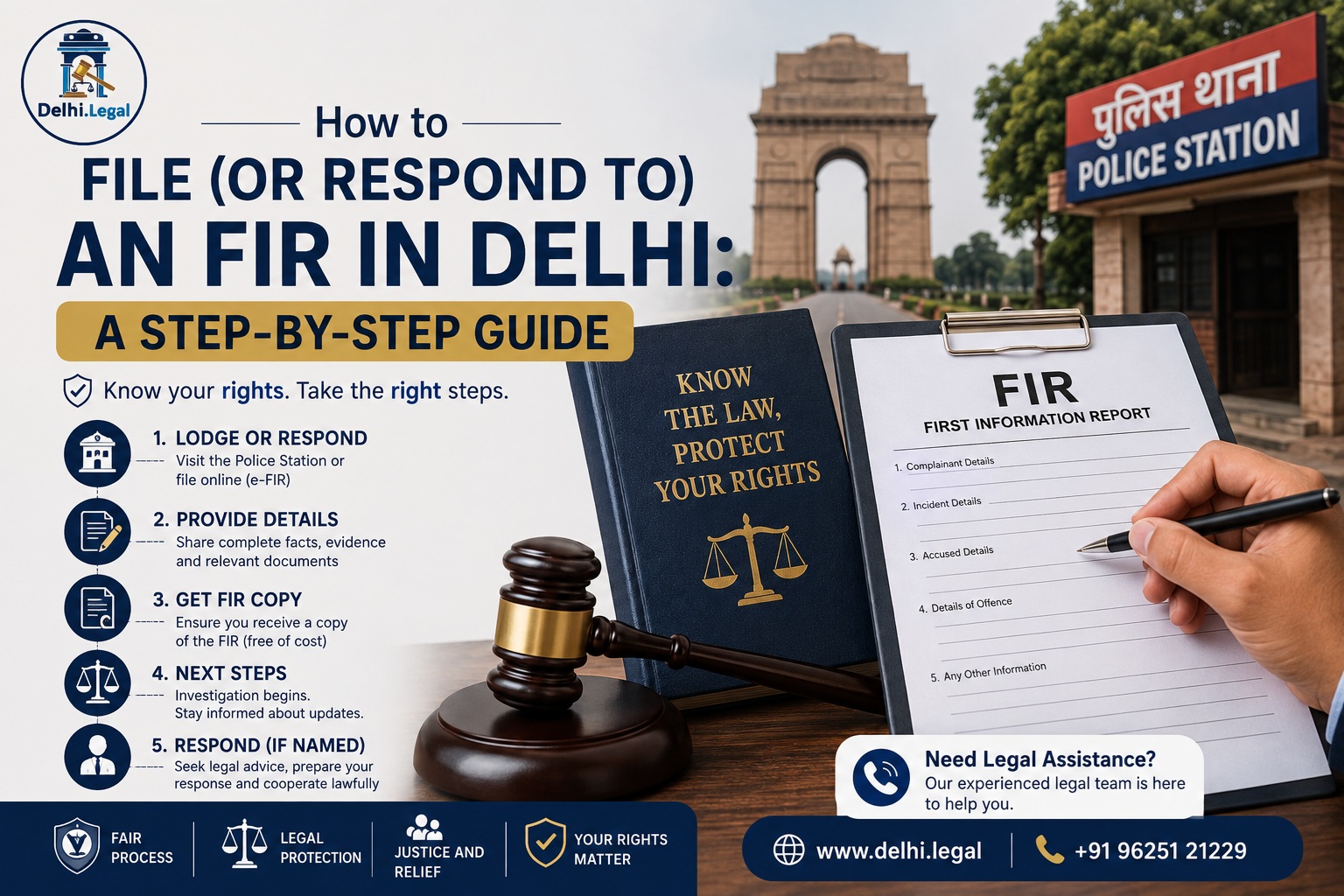

There is a specific kind of frustration that comes from standing at a police station counter while an officer explains, patiently and at length, why your problem is not really a police matter.
Sometimes he is right. Often he is not.
This guide covers filing a police complaint in Delhi from both sides: what to do when you need an FIR registered, and what to do when one has been registered against you. Both situations are more procedural than people expect, and both reward preparation.
Since 1 July 2024, the process is governed by the Bharatiya Nagarik Suraksha Sanhita (BNSS), which replaced the Criminal Procedure Code. Old CrPC section numbers are given in brackets where useful.
What an FIR is, and what it is not
A First Information Report is the written record of information about a cognisable offence, registered under Section 173 BNSS (old Section 154 CrPC). Cognisable means the police can investigate and arrest without a magistrate’s permission. Theft, assault, cheating, criminal breach of trust, rape, and murder are cognisable.
For non-cognisable offences such as simple defamation or public nuisance, the police record the information in a daily diary and cannot investigate without a magistrate’s order. That is an NCR, not an FIR, and people are frequently handed one without being told the difference.
An FIR is also not a finding of guilt. It is the starting point of an investigation. That distinction matters enormously to anyone named in one.
The FIR registration process, step by step
Go to the police station with jurisdiction. That is normally where the offence took place. If you are not sure, go to the nearest one anyway. See the Zero FIR section below.
Give the information, orally or in writing. If you speak it, the officer must write it down and read it back to you. If you write it, keep it factual and chronological. Names, dates, times, addresses, amounts, and what exactly happened. Leave out adjectives. A complaint that reads like a grievance letter gets treated like one.
Sign the recorded information. You are signing the police record, not just your own draft.
Get a free copy. Section 173(2) BNSS entitles you to a copy of the FIR free of cost. Do not leave without it. Note the FIR number, the date, the sections applied, and the name of the investigating officer.
Check the sections. This is where an experienced eye helps. The sections applied decide whether the offence is bailable, which court hears it, and how seriously the police treat it. A cheating case registered under the wrong provision behaves very differently in practice.
In Delhi you can also file online. The Delhi Police portal at delhipolice.gov.in accepts complaints for theft of vehicles, mobile phones, and documents, and lost-article reports. For other offences, the BNSS now permits an e-FIR, but the informant must sign the complaint within three days for it to be formally recorded.
Zero FIR: when the station says it is not their area
This is the most common obstacle in filing a police complaint, and it now has a clear answer.
A Zero FIR is an FIR registered at any police station regardless of territorial jurisdiction, given the number “zero”, and then transferred to the station that does have jurisdiction. It exists so that a victim standing at the wrong counter at 2 am does not have to travel across the city before anything is recorded.
Zero FIR came out of the Justice Verma Committee recommendations after the 2012 Delhi gang rape. It used to rest on circulars and Supreme Court directions. Under the BNSS it now has statutory backing in Section 173(1), which means an officer refusing to register one is refusing a duty imposed by law, not declining a request.
If you are told “this is not our area”, say the words Zero FIR. It changes the conversation.
What to do if police refuse to file an FIR
It happens. Sometimes because of workload, sometimes because the accused is locally connected, sometimes because the officer genuinely thinks it is a civil dispute. There is a defined escalation path.
Send a written complaint to the Superintendent of Police or DCP under Section 173(4) BNSS (old Section 154(3)). Send it by registered post or email and keep the receipt. If the DCP is satisfied a cognisable offence is disclosed, they can investigate directly or direct registration.
Approach the Magistrate under Section 175(3) BNSS (old Section 156(3)). This is the strongest remedy. The magistrate can direct the police to register an FIR and investigate. One important change under the BNSS: the application must now be supported by an affidavit showing you first tried the DCP route, and the magistrate has to give the police officer a chance to be heard first. So the paperwork matters more than it used to.
File a private complaint under Section 223 BNSS (old Section 200). Here the magistrate takes cognisance directly, records your statement on oath, and can summon the accused without the police being involved at all. Useful when the police route has failed entirely.
Use the online grievance channels. The Delhi Police public grievance cell and the Delhi Police Commissioner’s office accept written complaints. For serious matters, the Delhi State Human Rights Commission or the National Human Rights Commission are options where a refusal to register is itself misconduct.
For reference, the Supreme Court in Lalita Kumari v. Government of Uttar Pradesh held that registration of an FIR is mandatory when the information discloses a cognisable offence. That judgment is still the anchor for any argument on refusal.
If an FIR has been filed against you
Different problem, same need for speed.
Get a copy. You are entitled to it. If the station is unhelpful, most Delhi Police FIRs are published on the Delhi Police website within 24 hours, excluding sensitive categories.
Read the sections and check bailability. This determines whether you are looking at a notice or a possible arrest.
Do not go alone to “just explain”. People routinely walk into a station to clear up a misunderstanding and walk out having signed a statement that later reads very differently in a chargesheet.
Consider anticipatory bail. If the offence is non-bailable, an application under Section 482 BNSS in the Sessions Court is often the immediate step. The window is before arrest, not after.
Consider quashing. If the FIR discloses no offence at all, or is a pure civil or matrimonial dispute dressed up as a crime, a petition under Section 528 BNSS (old Section 482 CrPC) before the Delhi High Court can have it quashed. The threshold is high but the remedy is real, and the Supreme Court’s guidelines in State of Haryana v. Bhajan Lal still define when courts will use it.
Preserve your evidence now. Bank statements, WhatsApp chats, call records, emails, CCTV footage. CCTV is typically overwritten in fifteen to thirty days. Once it is gone, it is gone.
Practical notes for Delhi
Delhi has around 200 police stations across fifteen districts. The Cyber Police Stations handle online fraud and the Economic Offences Wing handles large financial cheating cases, so a complaint about a Rs 40 lakh investment fraud filed at a local station will often be transferred anyway. Filing at the right place saves weeks.
Keep everything in writing. Registered post, email with delivery receipts, acknowledged copies. In a system that runs on documentation, an undocumented conversation with a helpful officer has almost no value four months later.
Frequently asked questions
Q1. Is there a time limit for filing an FIR?
There is no strict limit for the FIR itself, but delay has to be explained. An unexplained gap of months weakens the case and is one of the first things a criminal defense lawyer raises.
Q2. Can an FIR be withdrawn?
Not by the complainant alone. Compoundable offences can be settled with the court’s permission. Others require a quashing petition in the High Court, usually on the basis of a genuine compromise.
Q3. What is the difference between an FIR and a chargesheet?
The FIR starts the investigation. The chargesheet is what the police file at the end of it, once they conclude there is enough material to prosecute.
Q.4 Can I file an FIR online in Delhi?
For specific categories such as vehicle theft, mobile theft, and lost documents, yes, through the Delhi Police portal. The BNSS also allows e-FIR for other offences, subject to signing within three days.
Q5. Do I need a lawyer to file a police complaint?
Not legally. But the wording of a complaint and the sections applied shape everything that follows, so it is worth having it reviewed before you sign.
Whether you are trying to get an FIR registered or have just been named in one, the first week matters most. Speak to the FIR and police complaint team at Delhi Legal to get your complaint drafted properly, or to understand your options if a case has been filed against you.